
Searching Pike County Civil Dockets
AlacourtACCESS, also called Just One Look, sells access to Alabama trial records. Case types include Civil, Small Claims, Domestic Relations, and other listed matters. The base charge is $9.99. You pay it even when the search comes up empty. A name search includes one detail, and each extra detail you select costs again. An exact case number saves you from wading through a common name. A Pike Circuit Civil number may look like CV-2026-000123.00. Domestic Relations uses DR. District Civil uses DV, and Small Claims uses SM. Copy the official number exactly and treat the prefixes only as guides.
The portal is not the only route. Call the Pike County Circuit Clerk at (334) 566-5113. You can view an open file free at 1318 North Three Notch Street in Troy, or mail a request there. Clerk hours run 8:00 a.m. to 5:00 p.m., Monday through Friday. A mailed request should list the case number, style, division, document title and date. Add the plain or certified choice, return contact, and a self-addressed stamped envelope. Confirm the fee and payee first. AlaFile serves registered e-filing and service, not the general public.
- Choose Circuit Civil, District Civil, Small Claims, Domestic Relations, or Probate from the claim type and amount.
- Gather the exact case number or the full public party name before opening a paid search.
- Review the $9.99 charge, submit the search, and confirm the court and case style before buying more details.
- Read the Case Action Summary, active settings, rulings, financial block, and available attachment list together.
- Ask the Pike County Circuit Clerk for an official file, missing image, plain copy, or certified judgment as needed.
Pike County Civil Docket Jurisdiction
Money and subject decide which Pike County civil docket holds a case. Pike Circuit Civil has exclusive original jurisdiction over claims above $20,000. It shares jurisdiction with District Court above $6,000. Small Claims sits inside District Court and caps claims at $6,000. It runs on a more informal bench process. District Civil handles claims within its statutory range. Domestic Relations, a Circuit division, deals mainly with divorce. Probate estates and other probate business stay with the Pike County Probate Court. Those matters do not sit with the Circuit Clerk's civil divisions.
| Pike division | General civil role | Record keeper |
|---|---|---|
| Circuit Civil | Claims above $20,000 exclusively; concurrent jurisdiction above $6,000 | Pike County Circuit Clerk |
| District Civil | Civil matters within District Court's statutory jurisdiction | Pike County Circuit Clerk |
| Small Claims | Claims up to $6,000 with Circuit appeal | Pike County Circuit Clerk |
| Domestic Relations | Divorce and related Circuit matters | Pike County Circuit Clerk |
| Probate Court | Estates and other statutory probate business | Pike County Probate Judge |
The official Pike Circuit Civil page sets out the Circuit jurisdiction lines and local filing context.
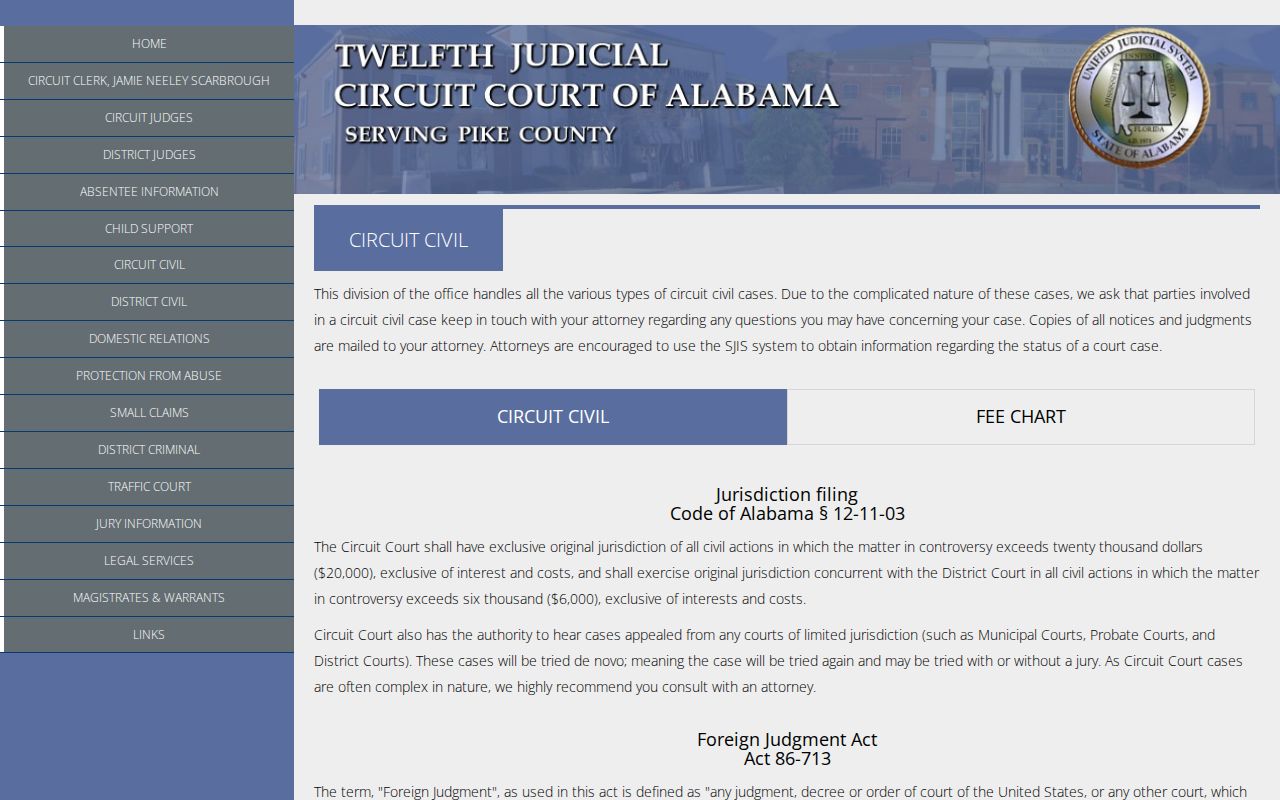
For higher-value civil matters, that division is where a Pike County court docket search should begin. Appeals placed in Circuit Court start there too.
Inside a Pike County Civil Docket
The header of a Pike County civil docket lists the case number, court, filing date, status, style, and public party roles. From there the event history follows the case through complaint or petition, summons, service, answer, counterclaim, amendment, motion, order, setting, continuance, trial, judgment, and appeal. After judgment, you may see garnishment, execution, satisfaction, or a certificate of judgment. Attorney names, costs, balances, and attachment markers can appear when public.
| Case number | The court, case type, year, sequence, and suffix; exact punctuation matters in a paid lookup. |
|---|---|
| Parties | Plaintiff and defendant, or petitioner and respondent, with attorneys when public. |
| Service | Issuance and return events showing the process used to notify a party. |
| Filings | Complaint, answer, counterclaim, amendment, motion, notice, or other filed paper. |
| Rulings | Orders granting, denying, setting, or otherwise resolving a request. |
| Judgment | Default, summary, trial, consent, dismissal, transfer, or other entered result and date. |
| Attachments | Images marked available after purchase of the case detail; a docket line is not the document. |
A web detail is just a convenience copy. When the wording of a judgment matters, inspect or order the signed document from the clerk.
Pike County Civil Docket Motions
A motion filed is not a motion granted. The first entry only records a party's request. A later order tells you whether the judge granted it, denied it, set a hearing, or did something else. The same caution applies to continuances. Filing one does not cancel the existing setting. Check the motion date, hearing notice, ruling, and newest setting before deciding what happened.
Use three checks. Find the request, locate the later ruling, and open the signed image or ask the clerk for it when exact terms matter.
A judgment line, a judgment image, and a certified judgment are three different things. The docket line records the event. The image holds the signed terms. Certification is the clerk's official authentication of a copy. Just One Look images cost $5 for the first 20 pages. Pages after that run $0.50 each. Pike's own schedule lists $0.25 per page for clerk copies under 20 pages. Certification there costs $5. Confirm the current total before you send payment.
Civil Case Types on the Docket
Pike County civil dockets hold many forms of noncriminal litigation. The subject and amount control the venue. A Case Action Summary may show contract and debt claims, injury or property disputes, domestic petitions, small claims, foreign judgments, and post-judgment work. Probate cases go through a separate office. Never pick the court from a broad civil label alone.
- Circuit Civil claims in the higher-value or nonmonetary jurisdiction stated by Pike County.
- District Civil claims within the lower court's statutory jurisdiction.
- Small Claims matters at or below the $6,000 ceiling.
- Domestic Relations cases, mainly divorce and related proceedings in Circuit Court.
- Appeals that create a Circuit case, including a new trial where the law provides.
- Post-judgment garnishment, execution, satisfaction, and certificate activity.
The Pike District Civil page identifies its filing channel and forms.
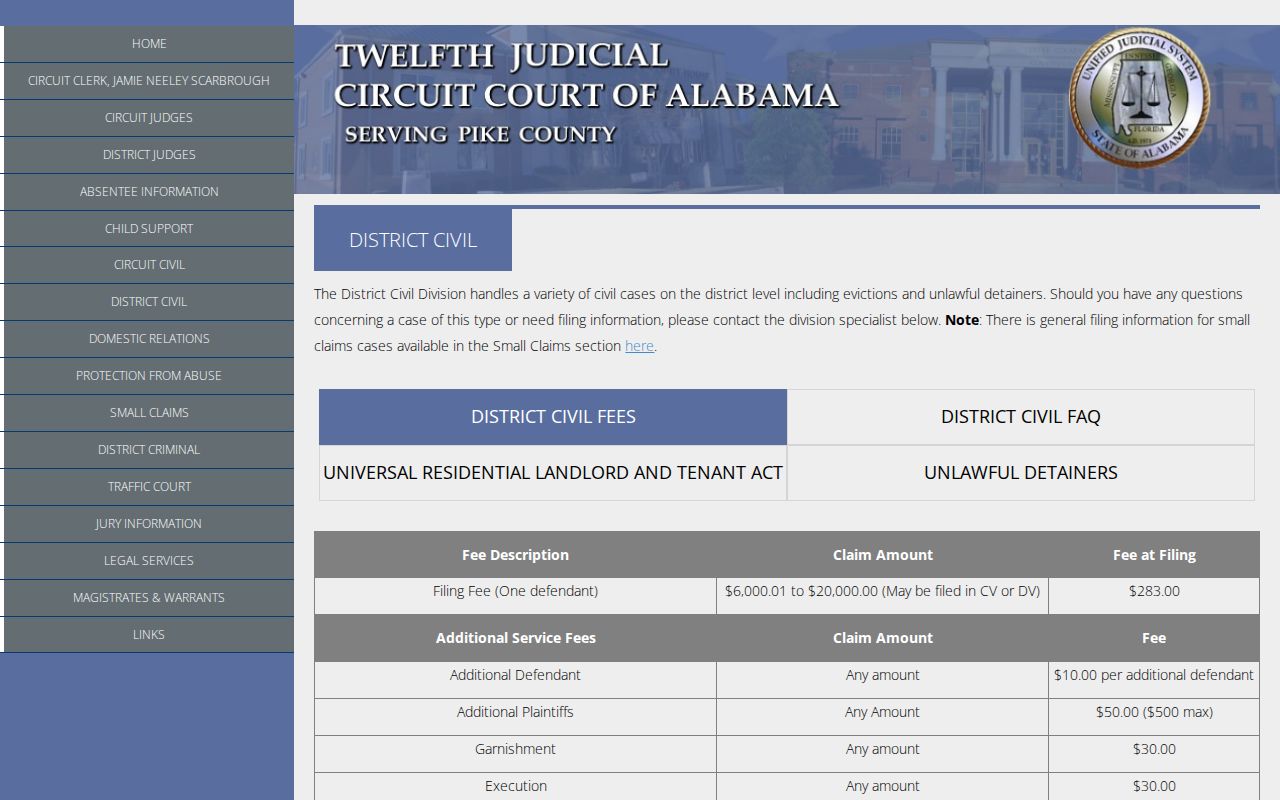
That local source can spare you paying for a Circuit result. The case may have started in District Civil instead.
Pike County Small Claims Dockets
A Pike Small Claims case begins in the District Court division. It is capped at $6,000. The docket opens with the claim and fee. It then may show service, an answer, a setting, bench trial, judgment, and collection steps. An appeal goes to Circuit Court, where the law allows a trial de novo. That means a brand-new trial, not a review limited to the lower record. The Circuit appeal carries its own activity. It may use a linked or new case number.
The official Pike Small Claims page publishes the ceiling, the appeal path, forms, and filing bands.
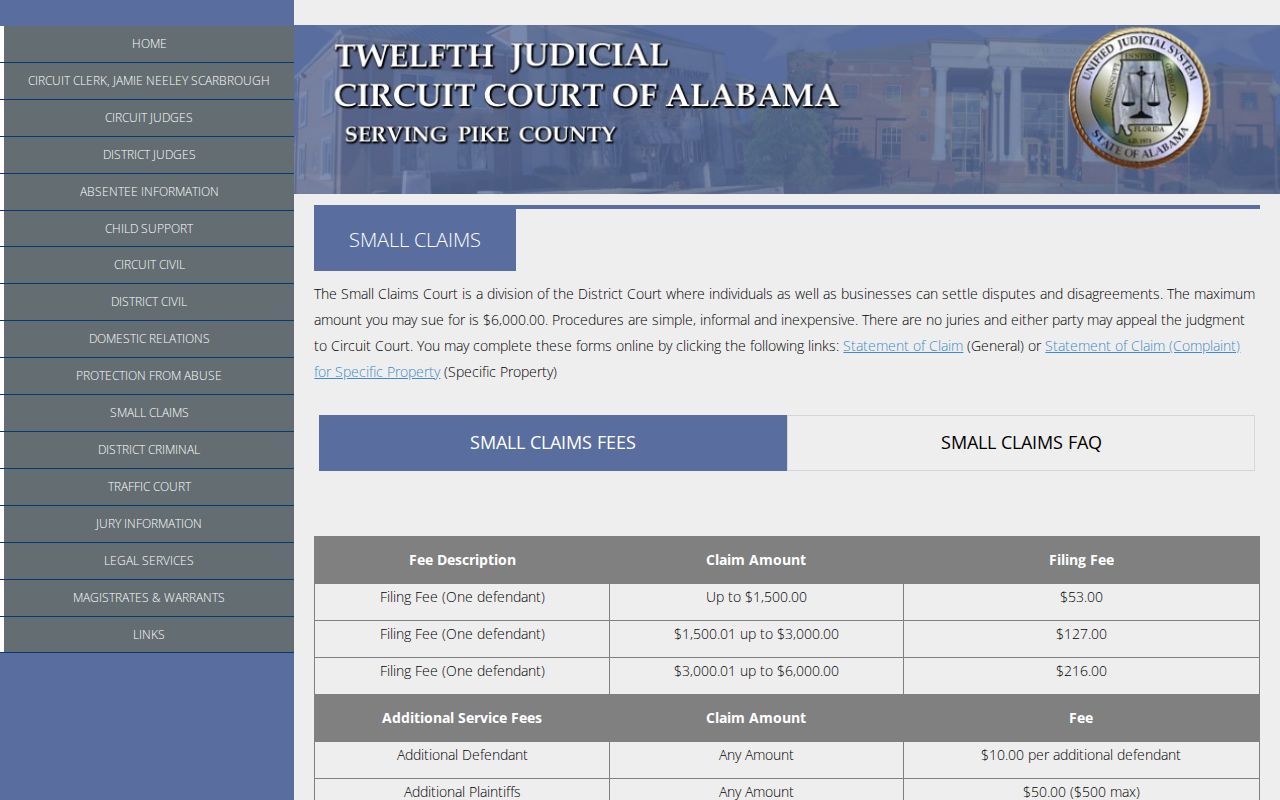
For a low-value Pike County civil docket search, Small Claims is the right place to start. It moves faster and costs far less than Circuit Civil. The published filing fee is $53 for claims up to $1,500, $127 from $1,500.01 through $3,000, and $216 from $3,000.01 through $6,000. Those figures are filing costs. They are not the price of copies. Fees can show up as entries on the docket. But they say nothing about who won or lost. The clerk hands out the forms. The clerk cannot fill them out or give legal advice.
Civil Docket Settings and Hearings
A civil hearing date in Pike County can surface in several spots. Check the Court Setting Dates block. Also check the separate Alacourt docket-list search, a clerk notice, an AlaFile service copy, or the judge's working calendar. The newest signed order or notice controls. Read it first. Then compare it against the active settings and the chronological Case Action Summary. A past date stays in the history after a reset. The first future-looking entry may no longer govern the case.
Domestic Relations cases carry a local trap of their own. Filing alone never sets a contested matter. Pike assigns contested matters and mails trial-setting notices to counsel. So a complaint date is not a hearing date. The Pike Domestic Relations page lays out that setting process and the local forms.
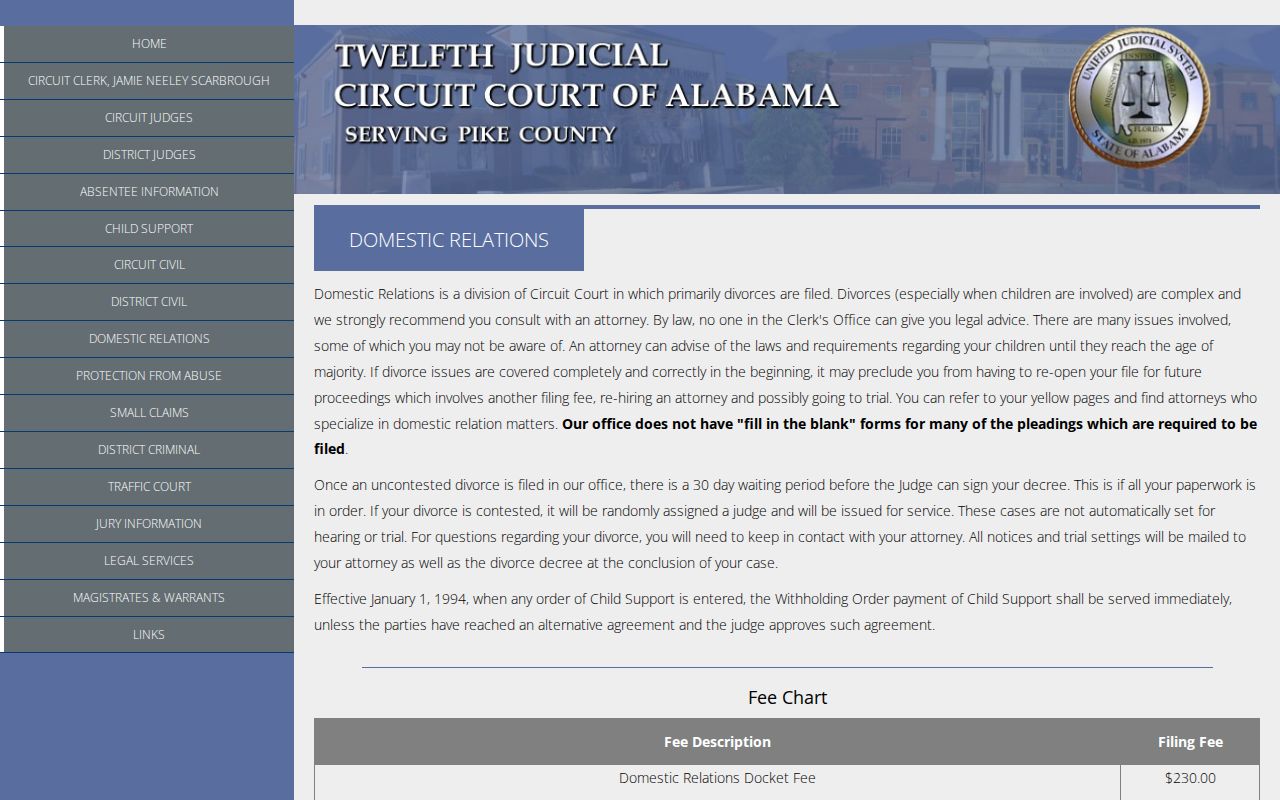
Because notices are served through the official process, the newest setting beats an old cached portal purchase every time. If a date looks wrong, call the Pike County Circuit Clerk with the exact case number, division, and disputed setting. The separate Pike County court dates resource digs into docket-list settings, resets, and missed dates.
Pike County Civil Docket Costs
Money entries in a civil docket can come from filing events, service, motions, or enforcement. None of them equal damages awarded. Nor do they match clerk copy fees. Pike's Circuit Civil schedule lists $282 for matters from $20,000.01 through $50,000. The same fee covers nonmonetary matters. Above $50,000, or when the amount is unspecified, the fee is $382. Workers' compensation filing runs $230, and a jury demand costs $100.
| Civil event | Published Pike fee | Docket meaning |
|---|---|---|
| Circuit Civil $20,000.01 to $50,000 or nonmonetary | $282 | Opening fee for that category |
| Circuit Civil above $50,000 or unspecified | $382 | Opening fee for that category |
| Workers' compensation | $230 | Case-type filing fee |
| Jury demand | $100 | Request event, not a trial result |
| Garnishment, execution, attachment, or writ of possession | $30 each | Post-filing or enforcement event |
| Subpoena | $12 | Process tied to a filed case |
Not every motion is free. Some motions for judgment, default, or summary judgment are listed at $50. An intervention, counterclaim, crossclaim, third-party action, or declaratory action is listed at $297. Confirm the current fee before you file. Statewide rule amendments can shift the schedules. And remember what a fee entry does not prove. An amount in the financial block is no sign that a motion was granted or a judgment paid.
Older Pike County Civil Dockets
Pike publishes no official archival year boundary for its older civil dockets. When an image is missing, consider several causes. The document may never have been scanned. It could be an older case, a restricted category, or a portal display gap. Check the exact number, court level, spelling, and suffix first. Then contact the clerk instead of paying for repeated guesses. Ask whether the public paper file or image can be viewed at the counter. For a copy by mail, identify the case, document title, and filing date. Be as precise as you can. Say whether you need a plain or certified copy. Confirm the total, payee, and delivery process. Rule 30 permits a clerk to run an archival search for a fee set under the governing directive. But the rule does not require it. Pike posts no archive-search rate or turnaround. Assume neither. A purchased portal snapshot can go stale. The clerk-controlled file remains the authoritative Pike County civil docket record.
Civil Docket Access Rules
Most ordinary Pike County civil dockets are open to inspection. But open does not mean everything sits online. Juvenile, adoption, sealed, and court-restricted material can be withheld. A domestic file may show only that a case exists while shielding children's identifiers, sensitive exhibits, or protected contact information. An empty online result is never proof that no case exists. For the framework behind it all, see the Alabama judiciary's Civil Procedure library. It gathers the rules. They govern civil filings, settings, dismissal, judgment, and other events.
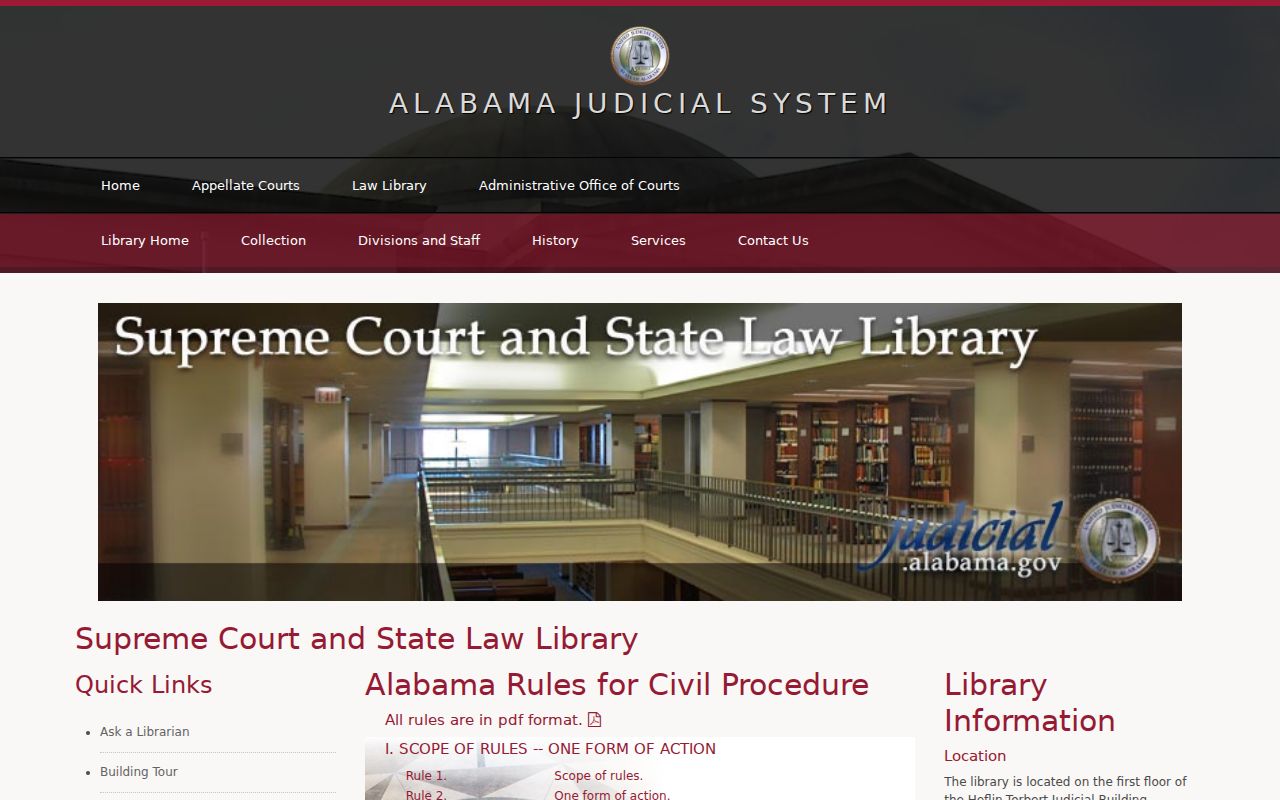
Those rules set out the legal steps. The Pike County civil docket shows when each step happened in a particular case.
Key access rules:
Ala. Code § 36-12-40 supports inspection and copying of public writings unless other law limits access.
Alabama Rule of Judicial Administration 30 preserves free inspection of open court files while restricting sealed or exempt material.
Alabama Rule of Judicial Administration 33 confirms that electronic-data rules do not remove courthouse inspection and copy rights.